FINE ART CONSERVATION, RESTORATION & COLLECTIONS CARE

March 2026

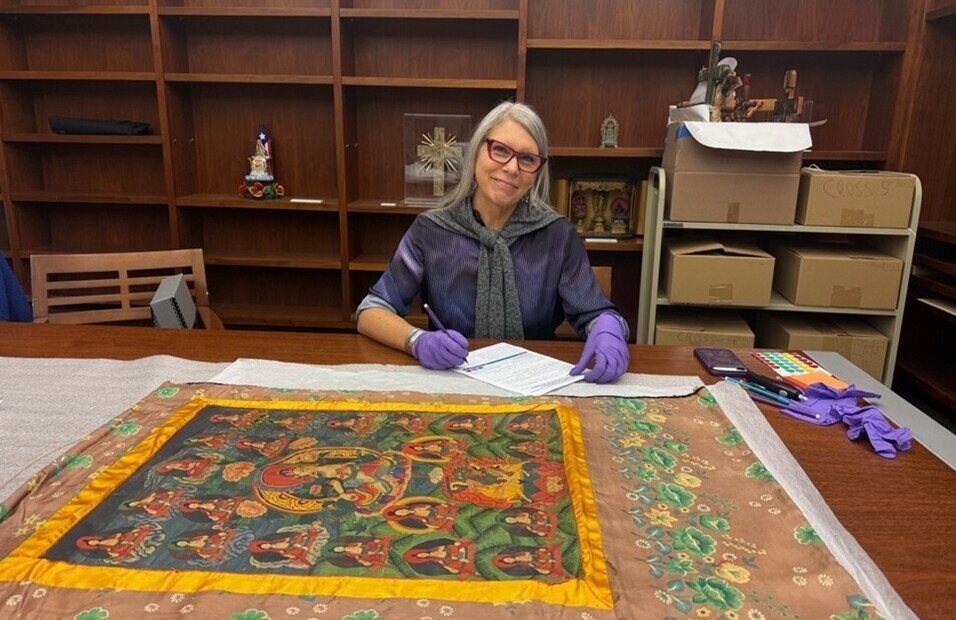
William H. Hannon Library, Pieper Collection of Religious Objects, 

Loyola Marymount University in 2025

(Photo Courtesy of: Loyola Marymount University)

DIRECTOR’S MESSAGE

Catching Our Collective Breath, and Catching You Up On A Few Project and Studio Highlights From This Past Year…

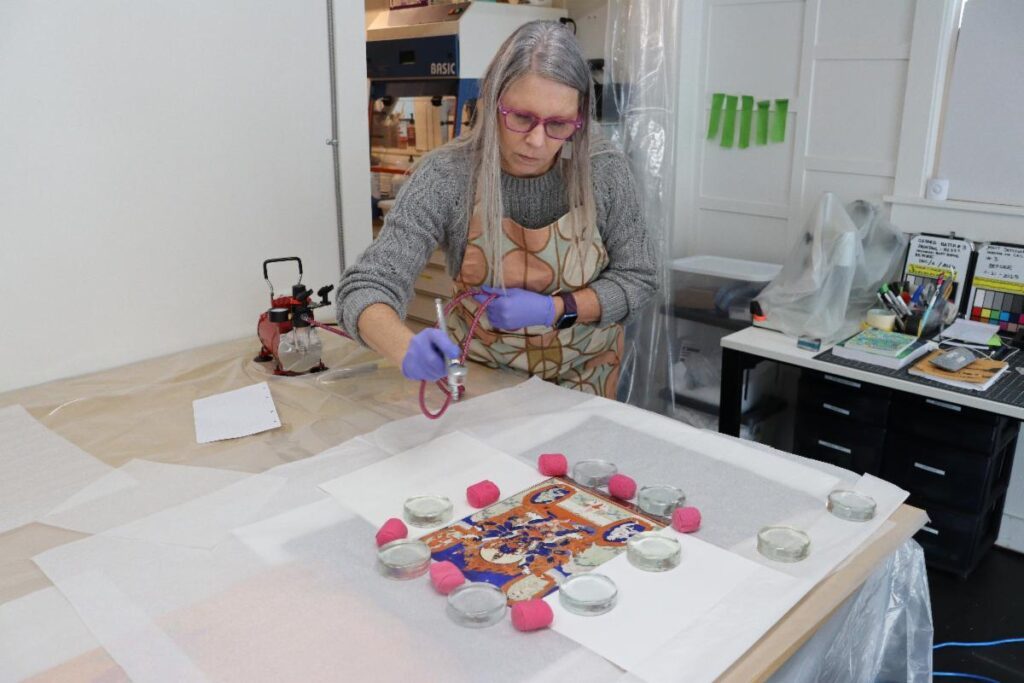
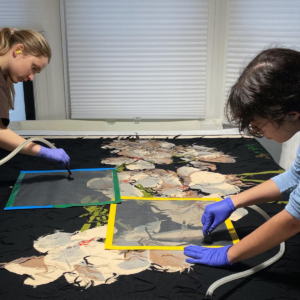
Looking back and looking ahead we continue to work at a break neck hectic pace, with numerous ongoing big inventory institutional projects with the de Saisset Museum at Santa Clara University, the SCU Jesuit Seminary, Museo Italiano, University of San Francisco, St. Ignacious Basilica, The National Park Service and National Trust, The Berkeley Art Museum and Pacific Film Archive (BAMPFA) at UC Berkeley, The Pieper Collection of Ethnographic Objects at Loyola Marymount University (LMU), The Dominican School of Philosophy and Theology…along with many other public and private sector clients. (Image shown above: Morin-Rousseau applying Funoran with an airbrush to consolidate fragile dry tempera pigment layers of an 18th c. Tibetan Thangka painting (Private Collection) while placed on a suction table.)

As a career professional interdisciplinary conservator, I have taught and instructed hands-on practicum internships for both pre-program and post graduate students from around the globe for the past twenty-two years. I know first hand how competitive the graduate program admission process is, with the thousands of hours needed in advance of the initial applications, and the years of dedicated work it takes to follow the long and difficult path to grad programs in Conservation Sciences and Museum Studies. We continue this valiant effort to mentor and support the next generation of aspiring young emerging cultural heritage preservation professionals.

Over the past five years I have been a guest instructor in four seminar/lab courses focusing on an introduction to conservation sciences, collections care, and conservation chemistry, related to textiles, works on paper, paintings, and wood and metal objects. These classes have been a unique cooperative effort between various university departments, including creating curriculum that thrived in our collaborative co-teaching format. It has been marvelous to watch our undergraduate students come alive with excitement and enthusiasm, once they have been introduced to the potential career paths that can be cultivated through knowledge of applied chemistry sciences, fine arts, the importance of cultural heritage preservation, and community stewardship.

I continue with my sincere commitment and dedication in working with Loyola Marymount University, in the development of an undergraduate minor in Conservation Sciences, and Core Curriculum coursework for students with Majors in Art History, Archeology, Textile, Costume and Dress Studies, Studios Arts and Chemistry—working in close partnerships with Professor Leon Wiebers, and Cynthia Becht, Head of Archives and Special Collection in the William Hannon Library at LMU. We have recently applied for the FAIC Molly Maxon Grant, in hopes of funding part of this effort—-fingers crossed.

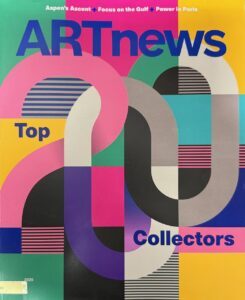
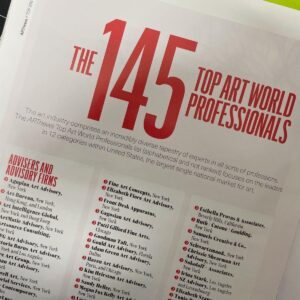
I am once again honored to share that our conservation studios were included the October 2025 “Top 200 Collectors” annual issue of ARTnews, feature article within “The 145 Top Art World Professionals”, listing twelve categories from the diverse art and museum industries, including Conservators. ACdR Art Conservation ~ SF, was top of the short list in good company with a dozen other well established and esteemed professional colleagues from across the U.S. for a 2nd year in a row.

This past year was I invited to join the FIRESAVE project, an international consortium of Cultural Heritage professionals based in the European Union, with partners at the University of Ghent, and KIK-IRPA in Brussels, Belgium, along with the GREEN-Art Project out of CSGI Florence, among many others. This project is in an initial development phase, but has the intention of building out international standards for emergency disaster response, remediation and recovery for wildfires globally.

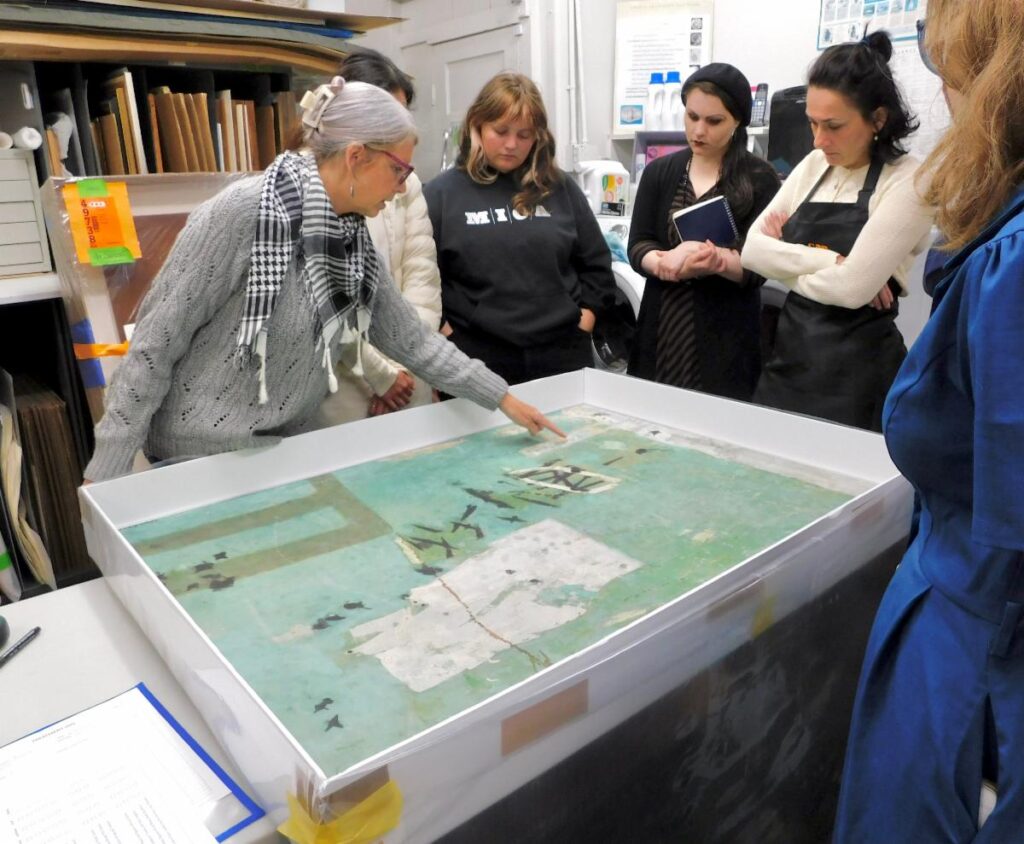
In early February, our studios hosted a three day hands-on practicum workshop for career professionals in paintings and paper conservators from institutions around the globe—-some twenty-five participants came from as far away as Hong Kong, Melbourne, London, Copenhagen, and across the U.S. We invited two renowned professors from the University of Florence, Chemistry in Conservation Scientific Research (CSGI), Piero Baglioni, and Giovanna Poggi, responsible for the breakthrough research and development of the NANO Restore gels and micro-emulsion colloidal fluids used in surface cleaning artworks. It was all very exciting and impressive to learn about these new treatment methodologies. We are already implementing this knowledge and materials science into our studios practice.

Earlier this March, we held an exhibitor’s table at the California Association of Museums (CAM) annual conference in Los Angeles. Thanks to those of you who visited us and said hello! Last year, the 2025 CAM meeting in San Francisco was fantastic and we also participated in the American Alliance of Museums (AAM) Expo Los Angeles in May, as well as, the Western Museum Association (WMA) Annual Conference in Reno, Nevada in September.

I will be presenting an academic paper and case study at the American Institute for the Conservation of Historic and Artistic Works (AIC) joint meeting the Canadian Art Conservation (CAC) in Montreal this May—discussing a project we featured in last years newsletter highlighting our on-site work on eleven historical 19th c. Chinese Lanterns at the Far East Cafe in San Francisco’s Chinatown. I will also be attending the International Council of Museums Conservation Committee Triennial Meeting in Oslo, Norway this September… So looking forward to these trips abroad focused on Cultural Heritage and conservation materials science.

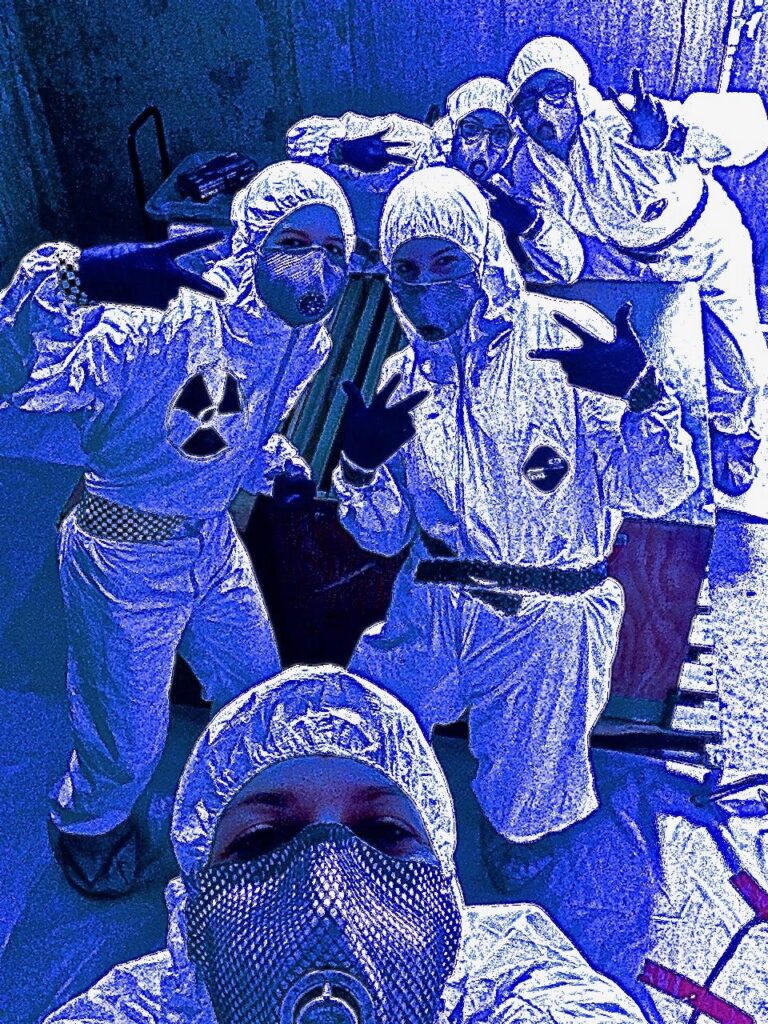
In today’s precarious economy, I am glad to be able to provide career employment for our permanent professional staff, along with paid internships per semester. Our studios are now comprised of three individual working labs, all within a three block walk—a total of 6000+ sq. ft. of climate controlled, implemented IPM working and storage space. We are able to conduct safe quarantine and isolation for contaminated and infested collections inventory prior to treatment— at the Annex & Hive. Our CO2 Anoxia oxygen deprivation encapsulation chambers, and custom bubbles in every dimension, are easily accessible to the adjacent, yet separated studio locations—plenty of room to keep our busy beehive actively working on many comprehensive and concurrent client projects in a well structured and organized manner.

Please let us know if we can be of assistance with any conservation, remediation, recovery, and preservation of fine art and cultural heritage materials. We have the expertise, are experienced, caring, and do good work for the greater good.

Let’s be good stewards together!

Warm Regards, Elise Yvonne Morin-Rousseau

Director, Principal Conservator and founder of ACdR Art Conservation, 

atelier studios established in 1999

OUR TOP 5 PROJECTS OF 2025

Gerhard Richter “Pyramide”, 1966

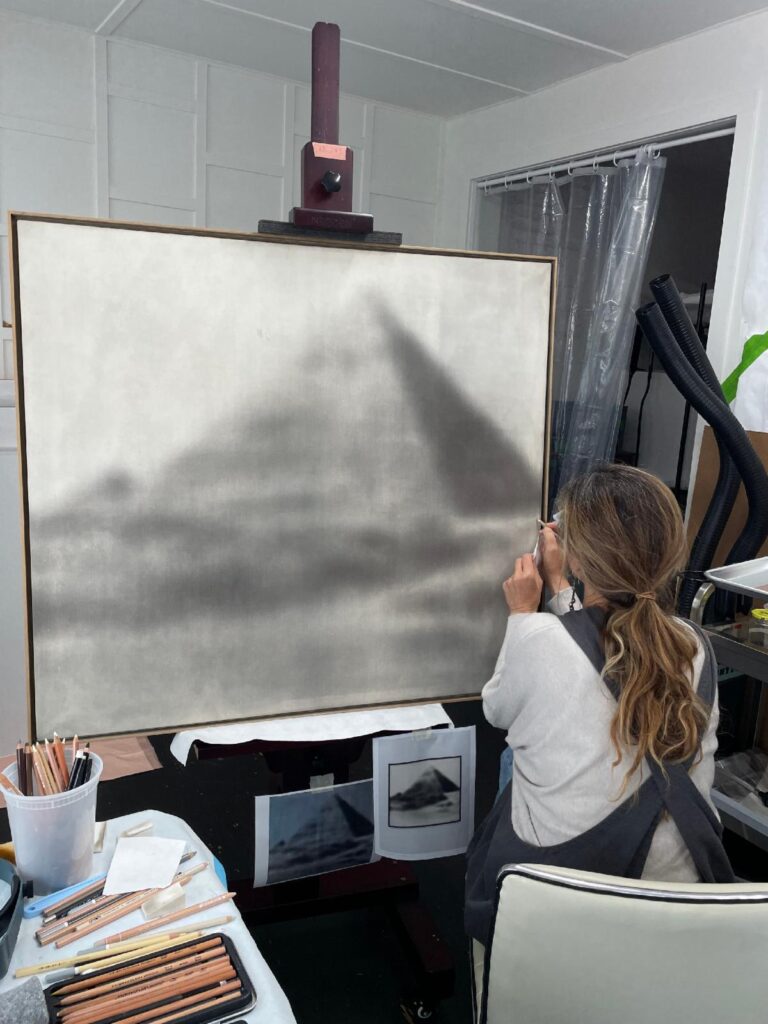
In 2025, we had the pleasure of treating one of Gerhard Richter’s ‘Pyramide’ (1966) series in studio. This multi-media work, from arguably one of the most renown artist’s of the 20th/21st centuries, had suffered water damage as a result of a flooding event.
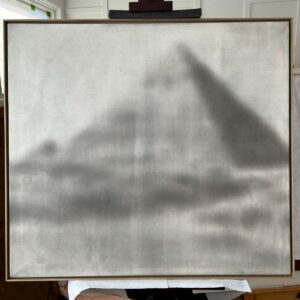
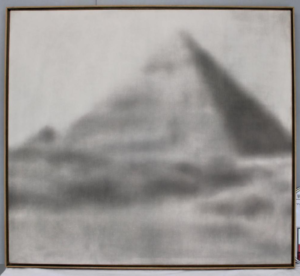
 
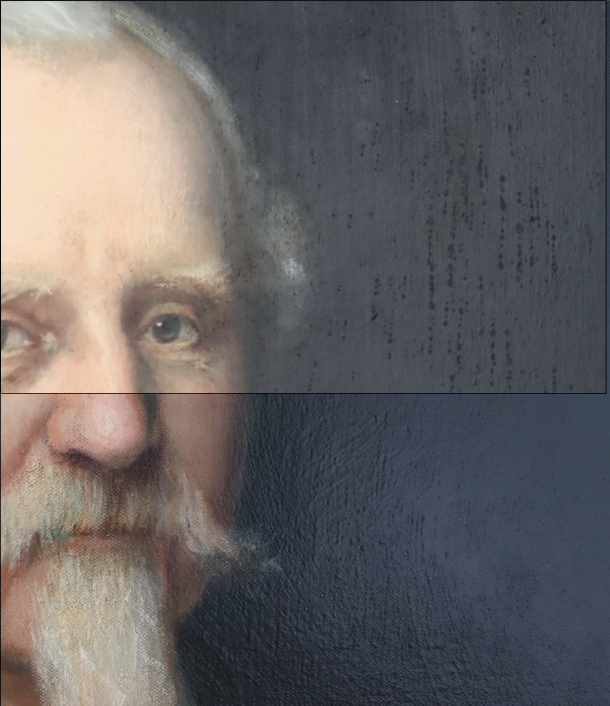
These photos illustrate the staining and bands of pigment loss/migration prior to conservation treatment. Our paintings conservator, Giovanna Carravieri, painstakingly, stroke-by-stroke, retouched this work using greyscale colored pencils and soft pastel powders using a pointillist method. In contrast, the final photos illustrate the dramatically more cohesive results after treatment – free from visual distractions and interference.
 
When approaching a modern work of this caliber, our first step is always research and reference – to best understand the artist’s intentions and practices. Once we had laid the groundwork, we then approached this artwork with a treatment protocol best suited to the media. The goal is minimal intervention to achieve the aesthetic initially intended by the artist.

Conserving Kennedy Family Treasures from

Maria Shriver’s Collections

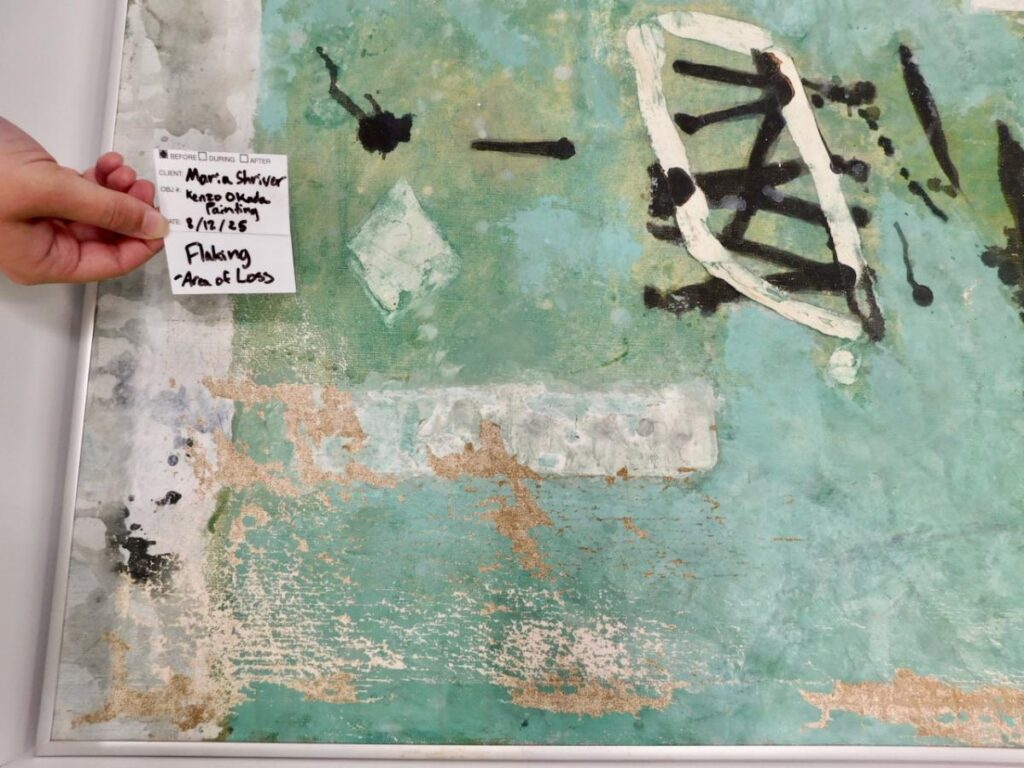
Kenzo Okada, untitled ~ oil on canvas, circa 1960 —This mid-century modern artwork was originally acquired by Eunice Kennedy, and was much beloved. Maria Shriver has many fond memories of this work of art from her childhood, and remembrance of her mother’s admiration for it, as it was a favorite of hers. 

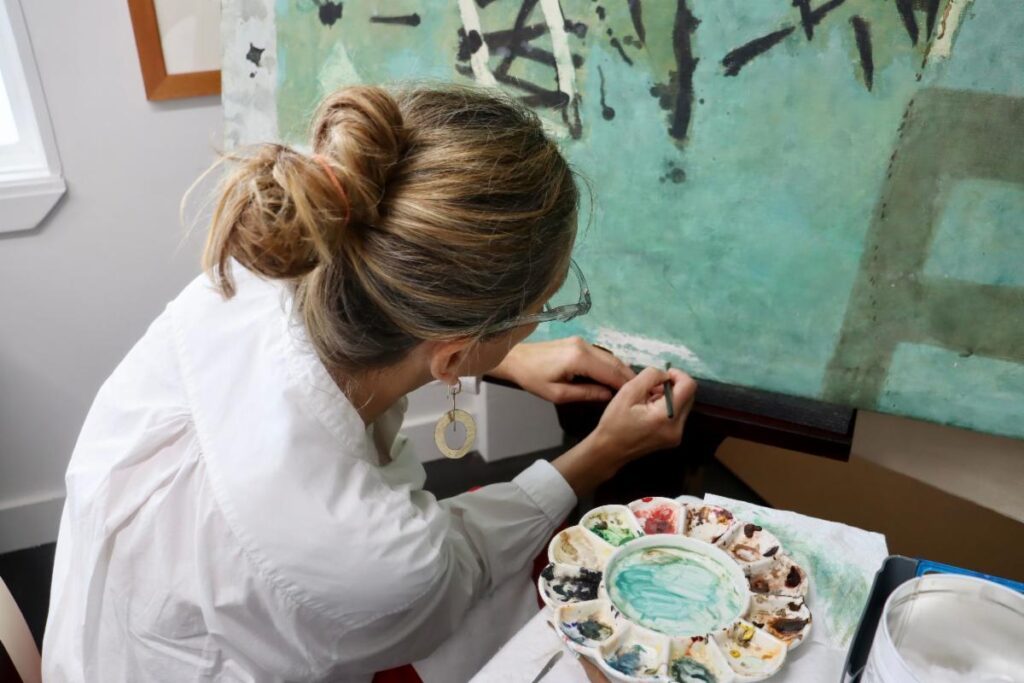
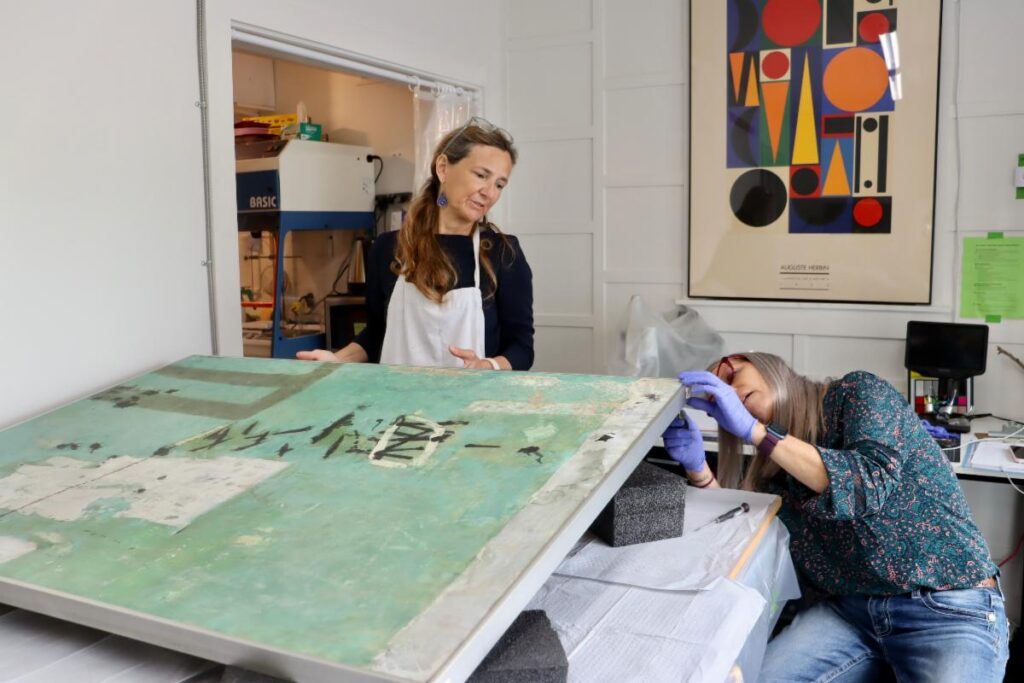
The client’s registrar records indicated that there was a small jagged edge tear in the central portion of the stretched canvas, and some visible brown discolored areas of staining. Additionally, we were able to observe and take notice of sections in the lower left hand corner and central bottom edge—where the original pigments were lifting, buckling, and flaking off of the canvas substrate, resulting in large areas of visible pigment losses. All of these issues were appropriately addressed with conservation and preservation treatment methods, that included: consolidation and stabilization of the pigment layers, removing the canvas from the stretcher, applying a strip lining support on our suction table, and flattening the distorted canvas, surface cleaning, in-painting and re-touching, then re-stretching the canvas back over the strainer supports. This artwork can now be enjoyed as treasured family heirloom for generations to come.

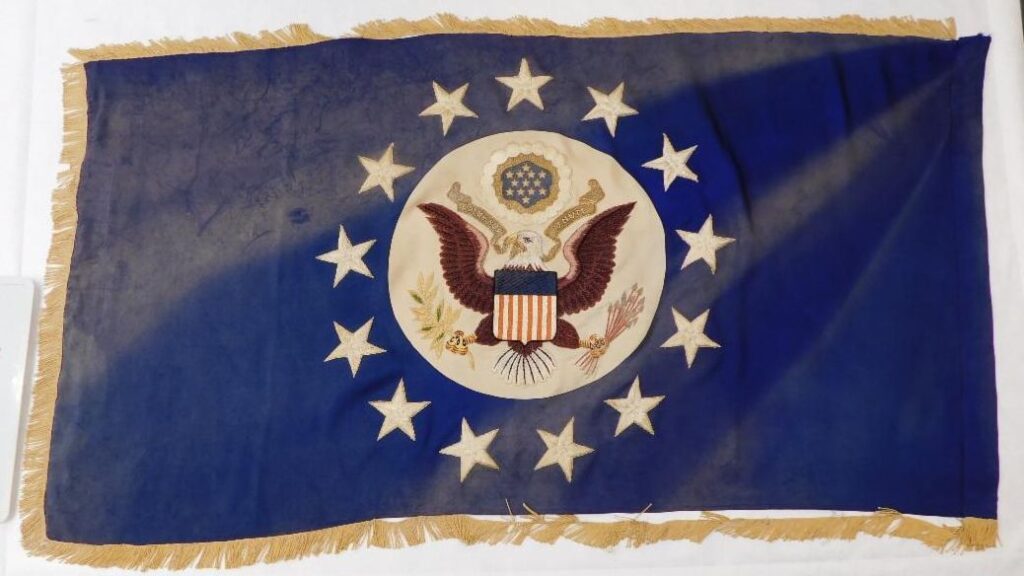
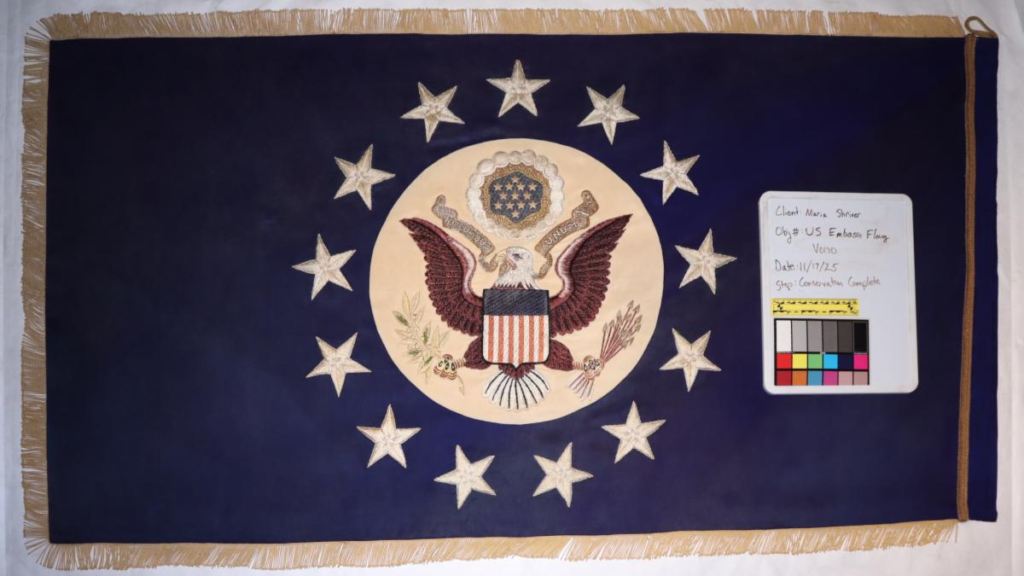
U.S. Embassy Flag, Paris circa 1968, U.S. Ambassador Sergeant Shriver—The Shriver family spent several years in Paris, in the late 1960’s when Sergeant Shriver, Maria Shriver’s father, was the U.S. Ambassador to France. This is the U.S. Embassy flag from his offices. The flag was in very poor condition, with severe fading from sunlight exposure, tears, staining, discoloration and unraveling braided fringe trim. This was a comprehensive conservation treatment undertaking. The flag was completely disassembled, the two sides separated, and the fringe fully detached. Our team endeavored to hand sew two new Evolon fabric interior support linings, adding structural integrity to the large 3-D embroidered appliqué motifs, creating a new sleeve for the flag pole mounting, hand coloring the faded silk ground, and polishing the original brass and wood flagstaff finial and base.


A Year of Tapestries

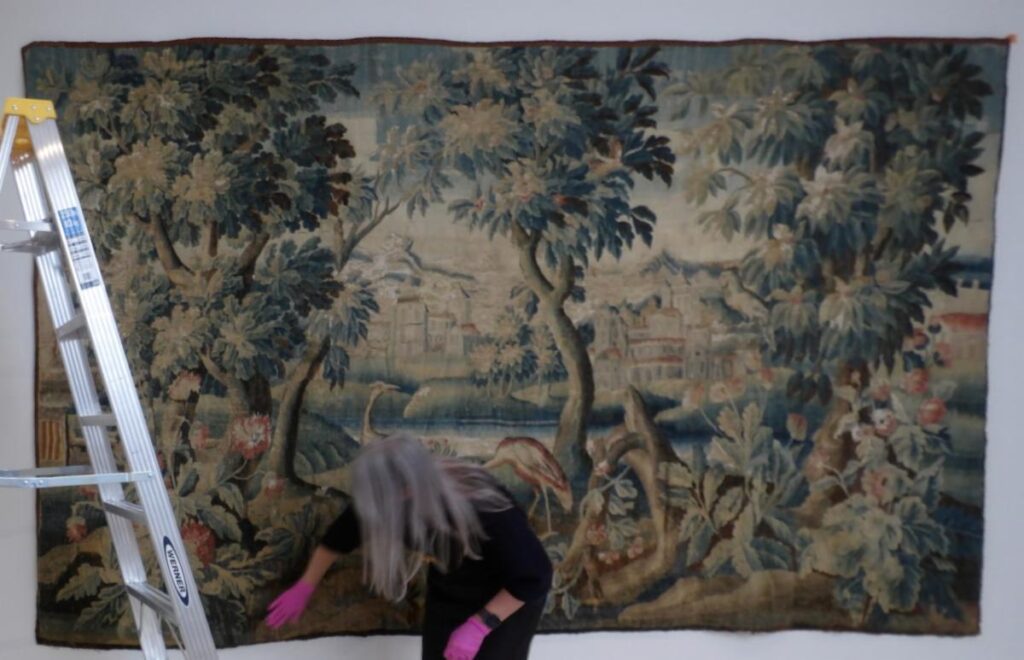
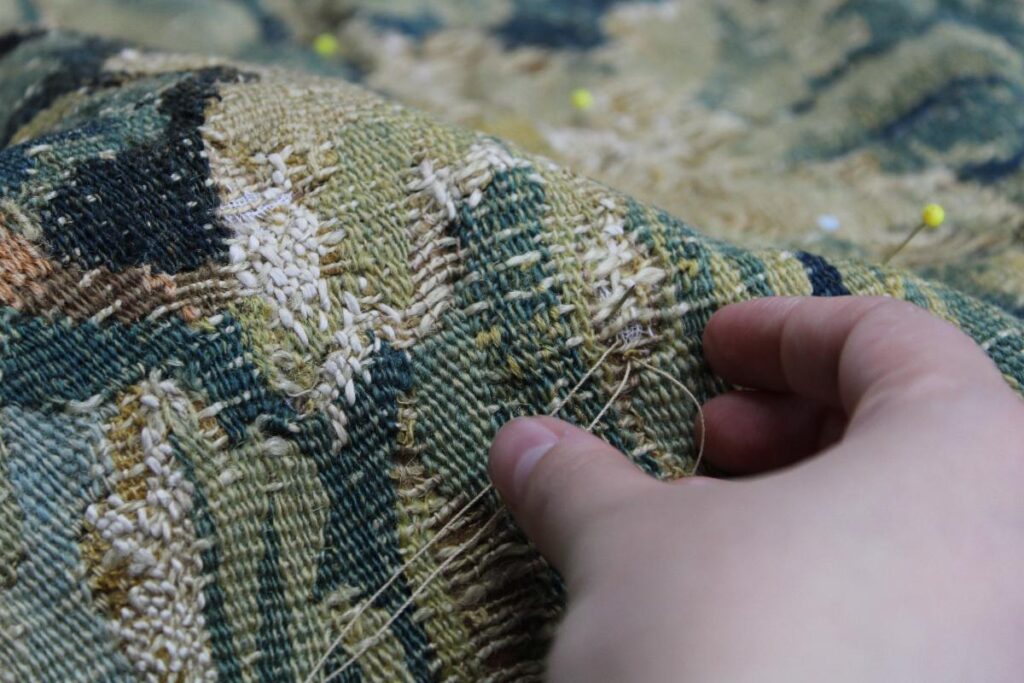
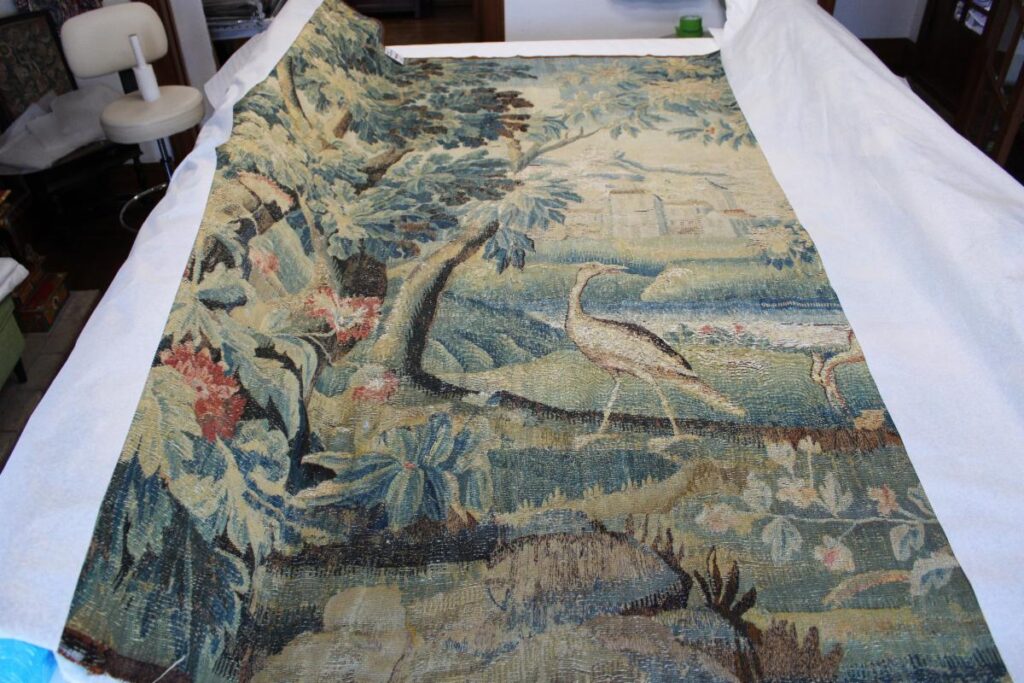
Tapestry is having a moment! From Medieval Flanders to Mid-20th century France to the Bay Area Textile Arts Movement of the 1970s, our 2024–2025 tapestry conservation projects have come full circle! Our conservation studios treated several 15th and 16th century tapestries throughout the summer and fall of 2024. More recently, a 17th-century tapestry entered our studios in the late summer of 2025 – and proved to be a far less straightforward project. Upon removing the previously added dust cover, we realized that one particular thread color had disintegrated – likely due to the mordant used to create that specific hue. This project is on-going through 2026 as the textile requires a very extensive consolidation and stabilization treatment protocol in order to be installed for long-term display.

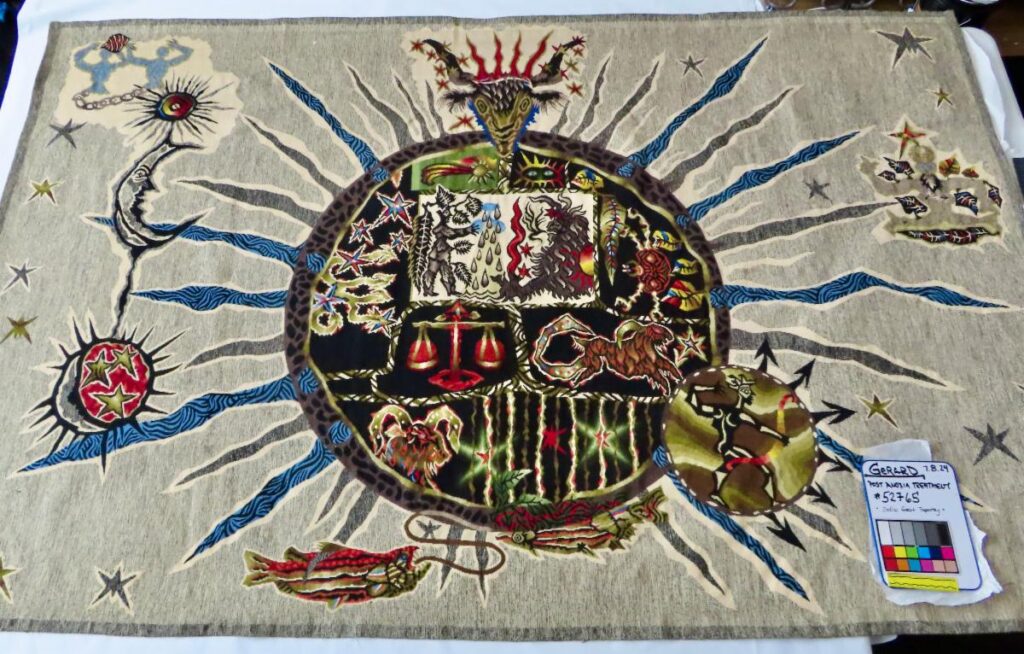
In an almost kismet kind-of through-line, our studios also had the pleasure of working on several significant modern tapestries in the Fall of 2024. Vintage Jean Lurçat-designed, Aubusson-woven tapestries, each handwoven circa the 1960s, came from a private estate in need of mold remediation treatment. There were five tapestries treated in our studios which were part of his Zodiac series, each depicting one of the twelve astrological signs – in his trademark saturated colors and energetic compositions.

Additionally, we treated Mark Adams’ ‘White Geraniums’ in our studios, which was woven circa 1966. This tapestry is one in an edition of four, woven in Vallauris, France by the Atelier Lagarde-de Quatrebarbes, a studio he frequently collaborated with between 1968 to 1980. ACdR’s studios were tasked with, first eradicating any lingering pest infestation, and then fabricating a custom hanging mechanism for this textile for a private client.

We anticipate future tapestry conservation projects will continue through 2026 as the medium itself is experiencing an aesthetic revival within Art, Architecture, and Interior design circles.

Jesuit School of Theology, Santa Clara University

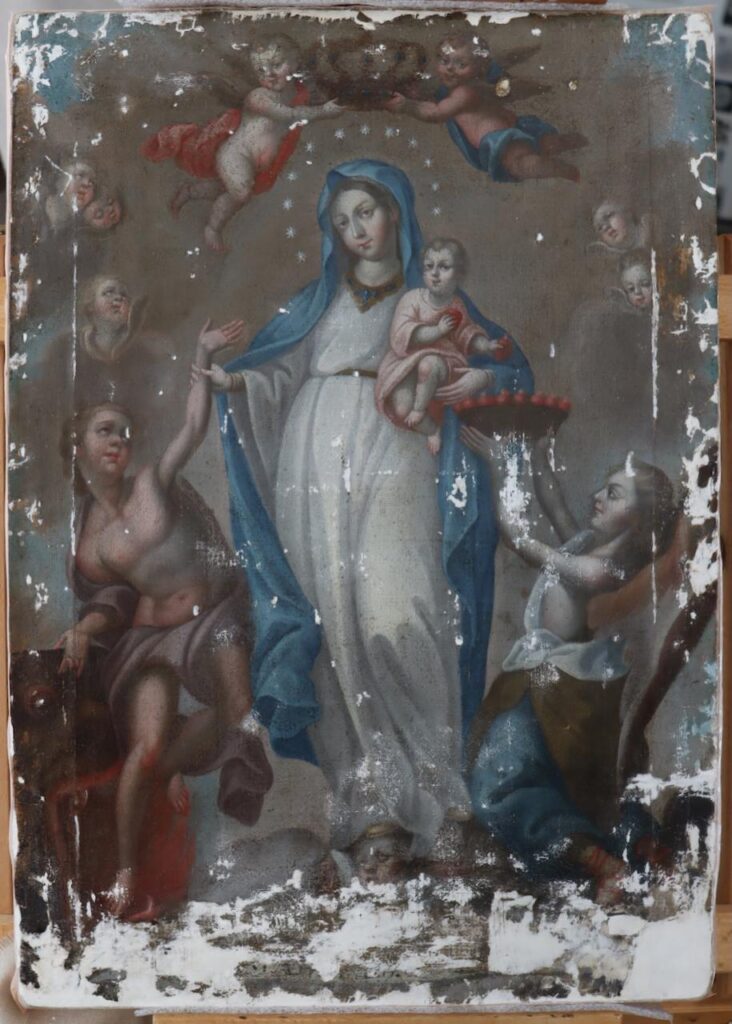
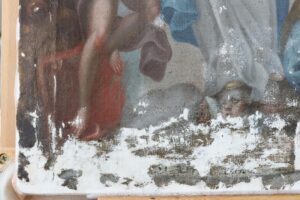
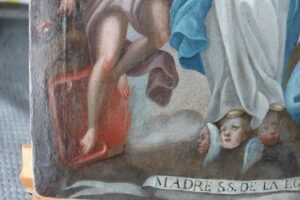
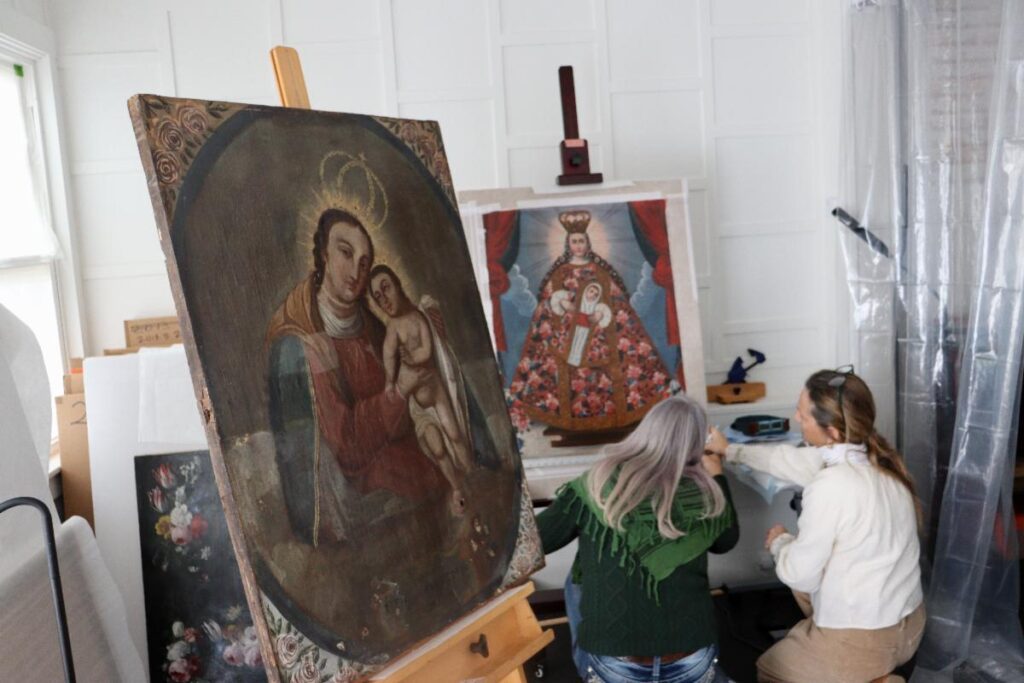
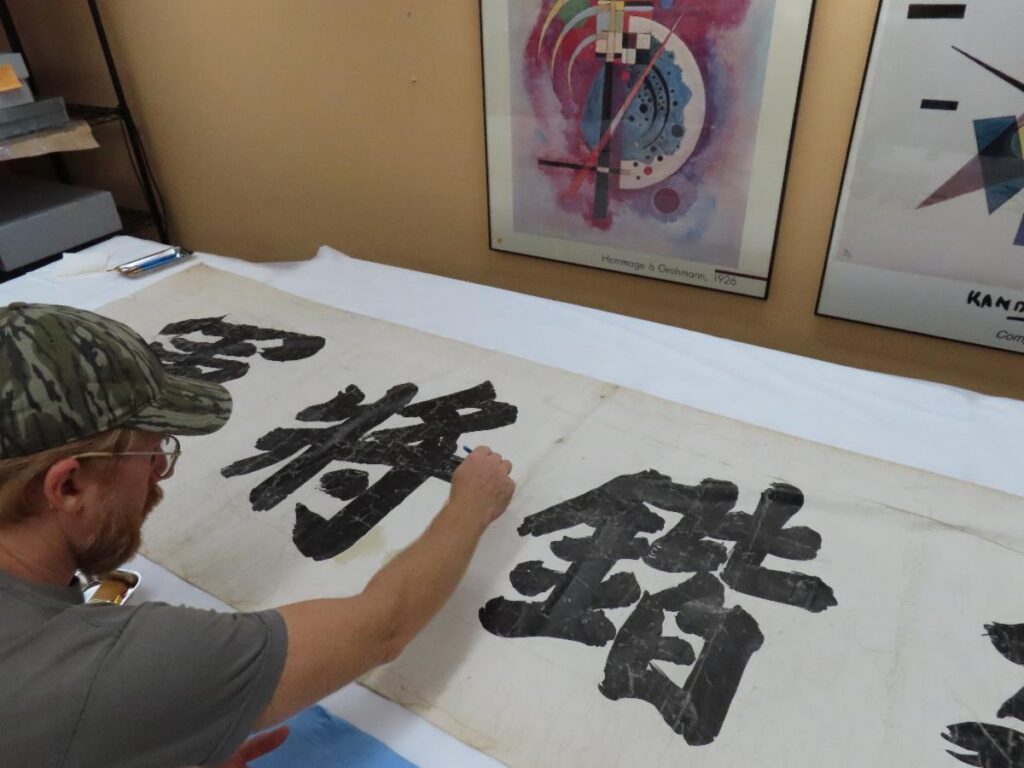
One of the more labor-intensive collections that underwent conservation treatment in our studios this past year, was a collection of 17th and 18th century Latin American and Spanish Colonial paintings from the Jesuit School of Theology and Jesuit Seminary of Santa Clara University. These works had numerous condition issues and showed evidence of previous restorations. Our paintings conservator, Giovanna Carravieri, along with our paintings conservation post-graduate interns, carefully and methodically treated each painting according to their individual needs.

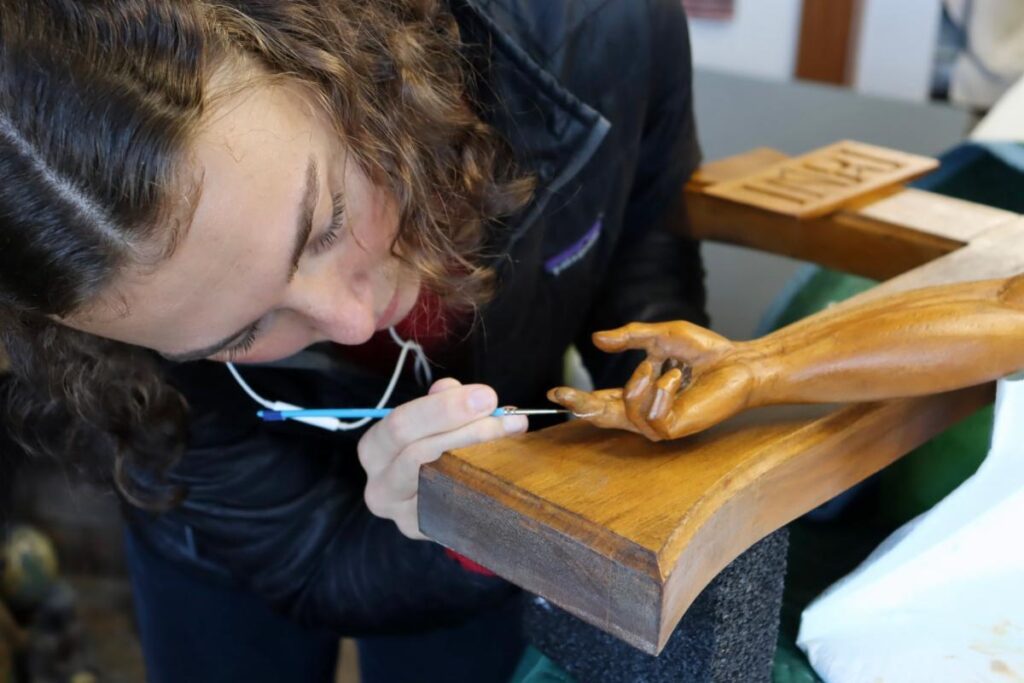
In addition, we treated a fairly large German pearwood crucifix which currently hangs in the chapel of the seminary. The many years on display and age of this object had resulted in accumulated dust and grime, embrittled cellulose fibers, and several breaks to the extremities. We cleaned, conditioned, and repaired this object so that could be re-installed for long-term display in their holy space.

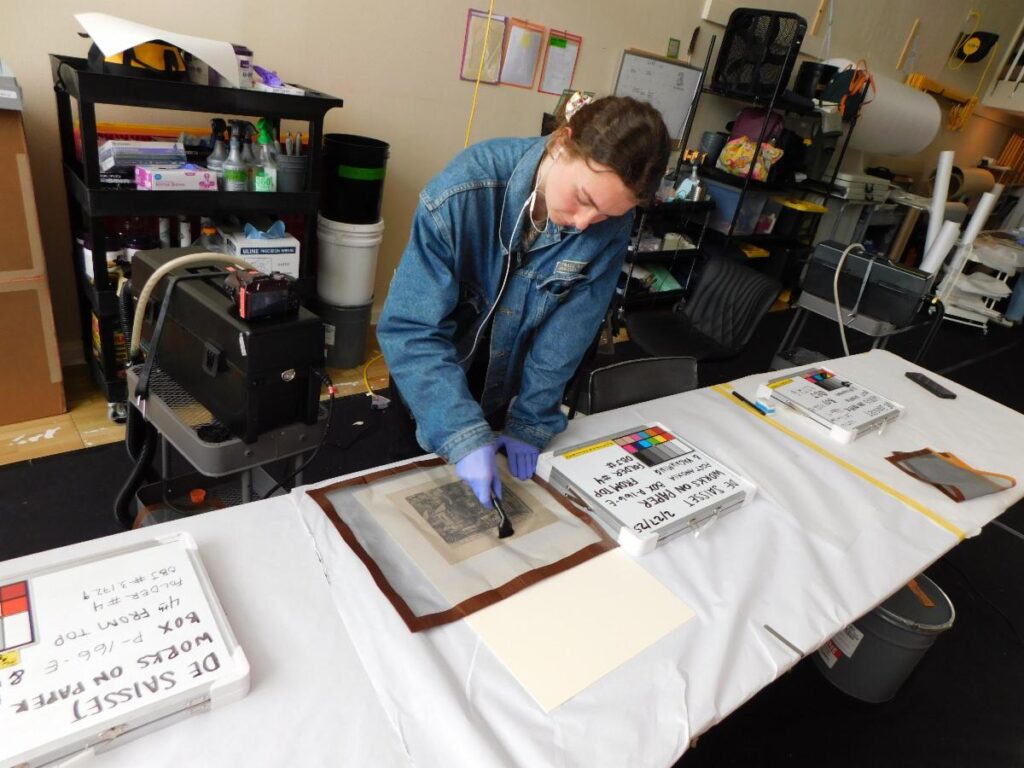
Works on Paper – The de Saisset Museum, Santa Clara University

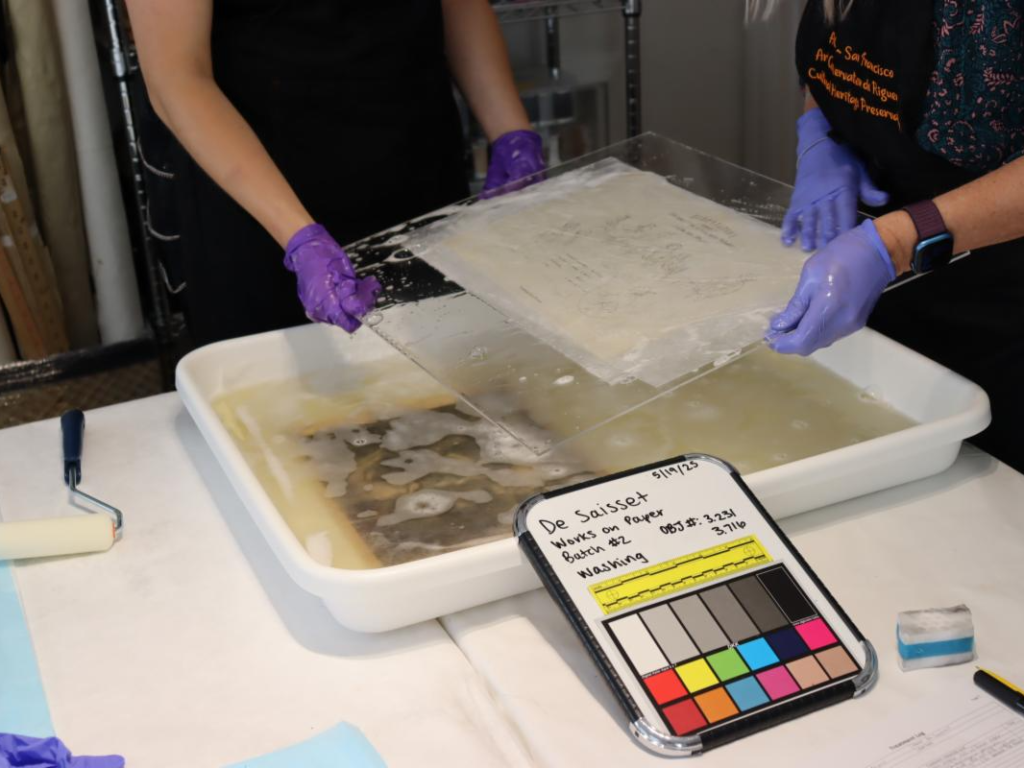
Since 2022, the de Saisset Museum of Santa Clara University has entrusted us to provide conservation and preservation services of their permanent collection as part of a disaster recovery project. Over the past year and a half, we have conserved several paintings created by the museum’s namesake Ernest de Saisset and by contemporary artists, as well as more than 800 other objects that were delivered to our studio or cared for on-site, including decorative arts and sculptures. The majority of these objects are from the museum’s impressive collection of works on paper and photography, which accounts for more than half of their collection and represents a broad range of art historical periods from Renaissance prints to Modern photographs and Contemporary monotypes. Examples of these works include etchings and lithographic prints of Catholic saints and other religious scenes, silver gelatin prints and Polaroids donated from the Andy Warhol Photographic Legacy Program, and the works of Imogen Cunningham.
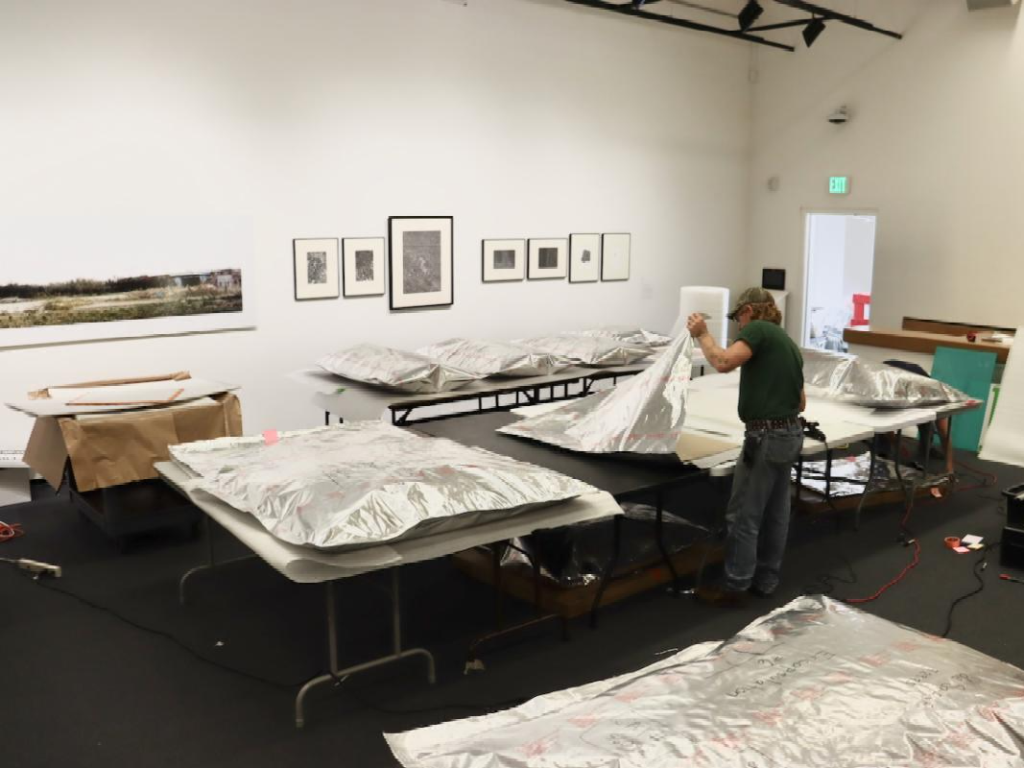
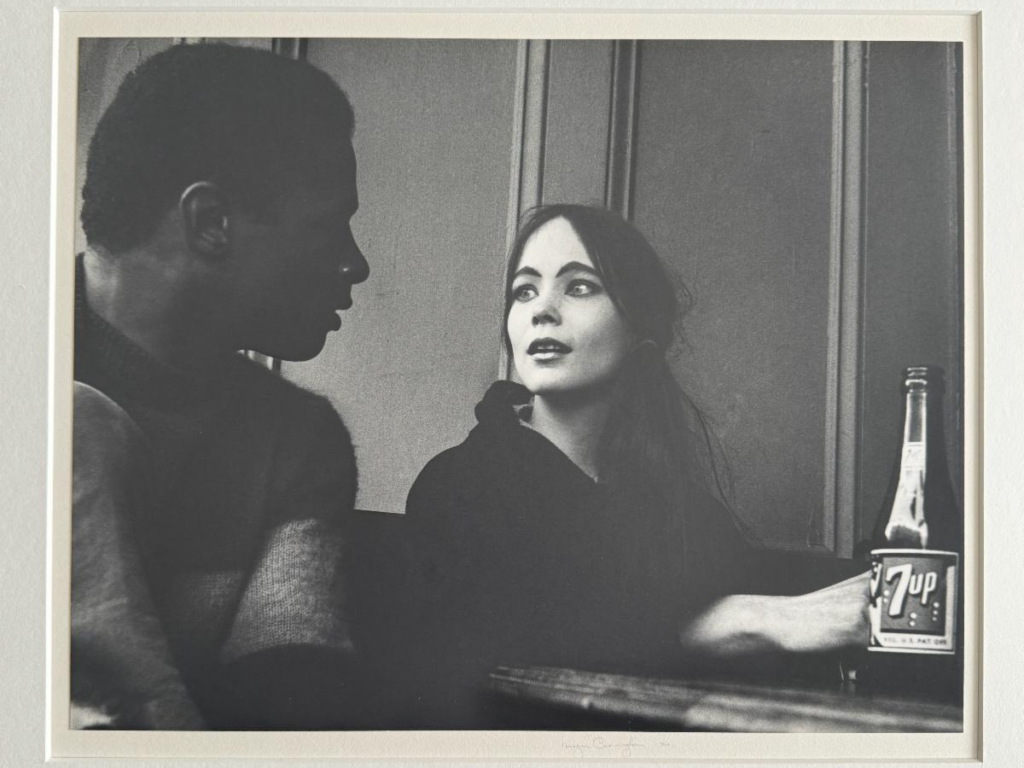
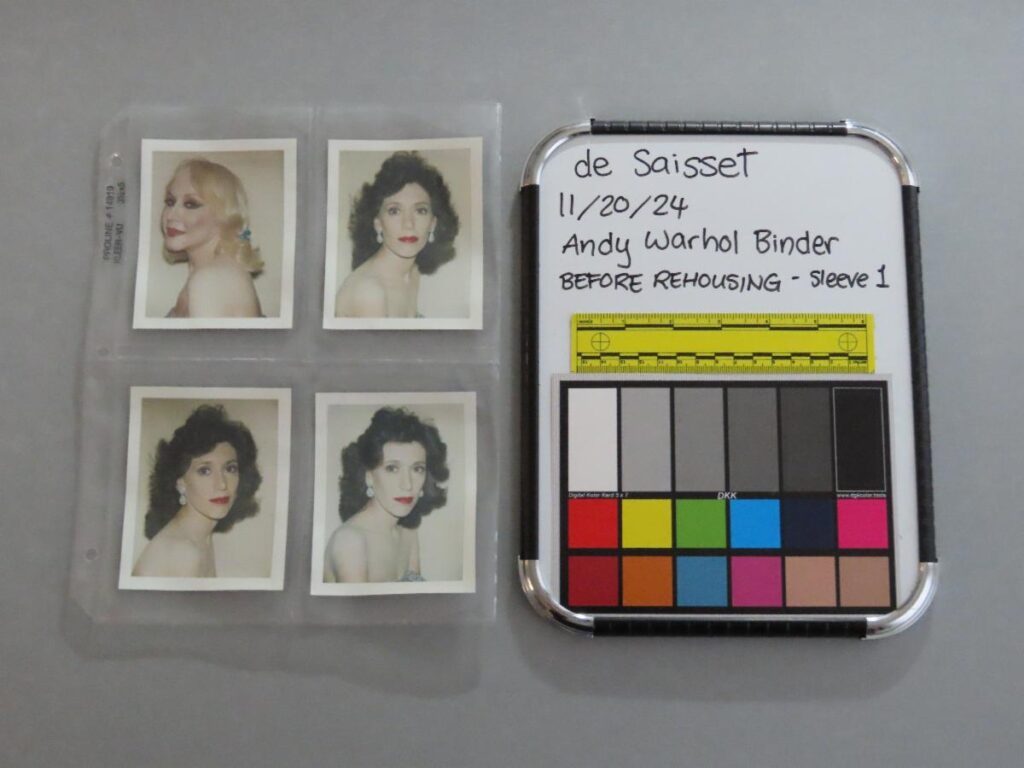
As with previous groups of works, the next 600 objects, will undergo CO2 anoxia oxygen deprivation encapsulation to mitigate exposure to any mold and microbial outbreaks. This will be followed by careful cleaning of all surfaces by micro-HEPA vacuuming. For a percentage of the works that also require acute attention, the majority of which are the prints from the Renaissance period, they may typically undergo a number of conservation treatments such as: handwashing and spot stain removal for works that have oxidized, turned yellow, or contain foxing; tear repairs; removing and replacing failing hinges and adhesive tapes; and customized housing for more delicate pieces.

MEET OUR STAFF

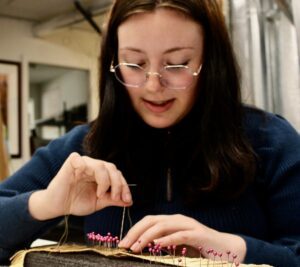
ACdR relies on its staff to uphold the utmost professional museum standards of practice and expertise specializing in conservation treatment and preservation. Along with an established mentorship practice for pre-program and post graduate interns from around the globe, our studios support the future professional development of art conservators through supervised, constructive, and instructive environments.

A Contemplative Practice: Ways to Be (and Stay) Creative in Your Work

~~~

Identify values/qualities you appreciate; keep these listed and close.

Don’t let the mundane stuff consume or take emotional precedence over creative vision.

Generate a totally out-of-the-box, wild idea first and then think about how it might work, even if it doesn’t.

Listen more completely—to staff, partners, colleagues, the universe.

Prioritize annual time to reflect on and check alignment among your mission, projects/programs, personal/staff passion, and community/societal needs.

Re-nourish your vision with contemplative walks, or by attending inspiring events (related or complementary to your mission), alone or with colleagues.


Nicolaus Chaffin
Conservation Technician and Preparator

Nicolaus has 20+ years experience as an arts worker in the the Bay Area holding roles ranging from Production Coordinator of Custom Framing, Museum Preparator and Conservation Technician to Collections Care & Management and Studio Assistant. In this time he has lead students at the California College of the Arts to actualize their Graduate Design Program Exhibitions, couriered and lead the installation of multiple complex artworks between institutions for exhibition both nationally and internationally, lead higher education classes on the impact of the AIDS crisis as witnessed through art and conducted research trips to conservation labs and storage facilities with a focus on cross-departmental collaboration and workflow. In his role at ACdR, Nicolaus enjoys in-painting, custom storage fabrication and developing installation strategies for non-traditional art and objects.

Jesus L. Torrez

Senior Conservation Technician, Preparator, and Facilities Manager

Rev. Jesus Landin-Torrez III, is an observer on the hyper-plane of space and time, trying to glide the contours of chaos with grace. Formerly known as a conceptual artist, community outreach archivist, museum curator, creative consultant, composer, gallery manager, studio manager, art handler, art teacher, music teacher, graphic designer, animator, hired gun guitarist, film maker, screen printer, actor, art director, tour manager, festival organizer, guitar technician, large machine operator, day laborer, and human Swiss Army knife. Landin-Torrez has been affiliated with these colonial cultural institutions: Berkeley Art Museum and Pacific Film Archive, Museum of African Diaspora, California College of Arts, Southern Graphics Counsel, Kadist Foundation, Anchorage Museum. Their greatest accomplishment to date is having their self-portrait hung in the Wisconsin State Capitol for Youth Art Month when they were 10 years old. Nowadays they spend their time arranging atoms and manipulating frequencies and in their spare time, at work they care for and preserve artifacts, art collection inventories, and manage the custom fabrication and operations of CO2 Anoxic Chambers.


Our Studio Mantra:

Do good work, be thorough, LISTEN intently, be observant,

SEE everything in your presence, be gentle, be kind, be OPEN.


OUR SPECIALTY SERVICES

FINE ART CONSERVATION, RESTORATION & COLLECTIONS CARE


A Multi-disciplinary Fine Art Conservation Center for the Preservation of Cultural Material and Artistic Works

Our conservation practice and analytical research lab specializes in the Conservation Treatment, Preventative Care and Preservation of Collections for a variety of materials and mediums which include: Paintings, Textiles, Historic Objects and Artifacts, Decorative Arts, Sculpture, Rare Books and Paper, Ethnographic Art, and other Ephemera.

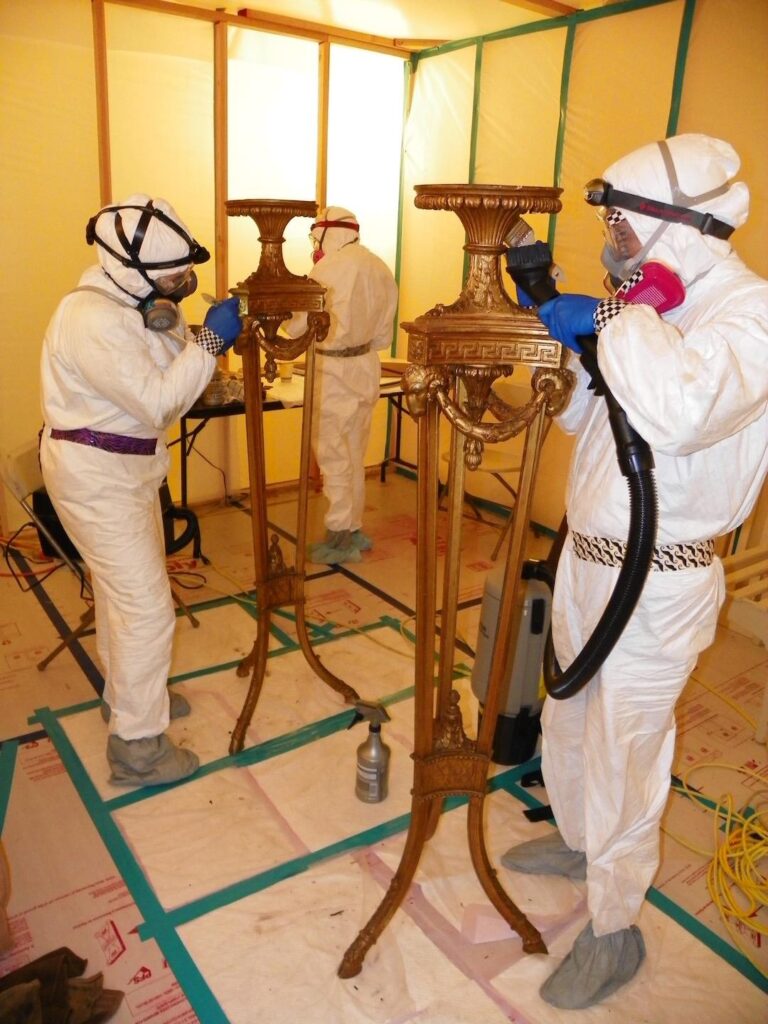
We provide expertise in Mold and Pest Abatement, Environmental Management, Emergency Disaster Recovery, Remediation, and Mitigation Preparedness services when fine art collections are damaged and contaminated by fire, smoke, floods, mold, and pest incidents, working in tandem with Insurance claim adjusters, and other vendors, such as re-building contractors, and house remediation companies. Our projects range from the minute to the grand. We will work with you to devise and design plans for practical conservation strategies.

  • Object and Collections Assessment Survey and Consultation 
  • Preventative Conservation Collections Care
  • Archival Collection Storage and Housing
  • Integrated Pest Management and Mold Abatement
  • Conservation, Preservation, Cleaning and Repair
  • Custom Object Support Structures
  • Condition Reports and Digital Photo Documentation
  • Insurance Claims and Recovery
  • Emergency Disaster Planning and Recovery
  • Mold, Microbial, and Pest Infestations
  • Fire, Smoke, and Soot Damage
  • CO2 Anoxia Abatement – Encapsulations and Modules
  • Surface and Wet-Cleaning
  • Hand Sewn Repairs and Consolidation
  • Mount Preparation and Fabrication


CONTACT US

We can provide the expertise in this highly specialized field!

Studio Tel. (415) 751-2540 | Email. ACdRConservation@icloud.com


ACdR Art Conservation ~ SF

All work is performed according to the Code of Ethics, Guidelines, and Standards of Practice of the American Institute for the Conservation of Historic and Artistic Works (AIC), The International Institute of Conservation (IIC), AIC Conservator in Private Practice (CIPP), ICOM-CC, ICDAD, Western Association of Art Conservation (WAAC), Bay Area Art Conservation Guild (BAACG), Association of Registrars and Collections Specialists (ARCS).

acdrconservation.com

Instagram  Web  LinkedIn